Projects

Systems that had to work
where nobody was watching.

A selection of programs I architected or led — each one with the illustration of what was actually delivered, and links out to the platforms, products and organizations behind them.

Autonomous Caterpillar dozers and a grader working a large earthmoving site, seen from above.
Heavy machinery working a live site — the fleet a single operator has to be able to hold.

HavocAI (Teleo)2024 — 2025

Supervised autonomy for heavy vehicle fleets

Industrial sites run on heavy machinery and the people who sit in it. Supervised autonomy only changes that economics if one operator can hold several machines at once — which turns out to be a communications problem long before it is an autonomy problem.

  • Architected ultra-low-latency, high-bandwidth communication infrastructure spanning expansive industrial sites
  • Engineered and optimized high-performance video transmission pipelines
  • Enabled a 1:N operator-to-machine ratio, significantly increasing operational throughput
  • Bridged sales, deployments and operations so infrastructure requirements matched what the field actually needed
A V-BAT uncrewed aircraft hovering above a ship's flight deck at sea before landing.
V-BAT recovering to a deck at sea — the landing case that precision localization exists to make routine.

Shield AI2022 — 2024

Autonomy integration & avionics on the V-BAT

Getting an autonomy suite onto a flying platform is a systems problem: the software has to land on hardware that is reliable, updatable, standardized across a fleet, and provably ready to fly before anyone launches it.

  • Autonomous systems integration — led integration of the Hivemind AI autonomy suite onto the V-BAT platform, enabling mission-level intelligence
  • Avionics modernization — re-architected legacy avionics and ported firmware to a high-performance distributed microcontroller platform
  • Organizational standardization — established the NVIDIA Jetson ecosystem as the org-wide edge-compute standard, streamlining AI model deployment across the fleet
  • Vehicle health & safety — engineered VHM systems and automated pre/post-flight evaluation for a 100% operational readiness envelope
  • Precision localization — developed novel short-to-medium range positioning for high-assurance landing in complex or contested environments
  • Mission-specific AI evaluation — analyzed vision and AI platforms for high-endurance, wide-area search
Wireframe visualization of a rig floor with LiDAR-derived geometry, machinery and a person highlighted in green, with hazard zones shaded red.
Live LiDAR reconstruction of a working deck — people in green, hazard zones in red, computed on the machine.

Microsoft · The Marsden Group2019 — 2020

Embedded AI, perception & network optimization

Making real-time perception fit inside the power and latency budget of a machine in the field — then making sure the data could actually get off it. The work shipped as VisionIQ, a LiDAR-and-vision safety system for offshore rig floors.

  • Optimized CNN inference on NVIDIA Jetson platforms using Tensor Cores: 4× faster at lower power
  • Built high-performance LiDAR processing pipelines with a 500× improvement in execution time
  • Achieved a 20× reduction in network latency through kernel-level and TCP stack tuning
  • Designed adaptive camera algorithms for real-time exposure and focus control in variable lighting
  • Built self-discovering wireless mesh protocols with dynamic load balancing
  • Managed end-to-end hardware/software integration: sourcing, thermal management, physical optimization
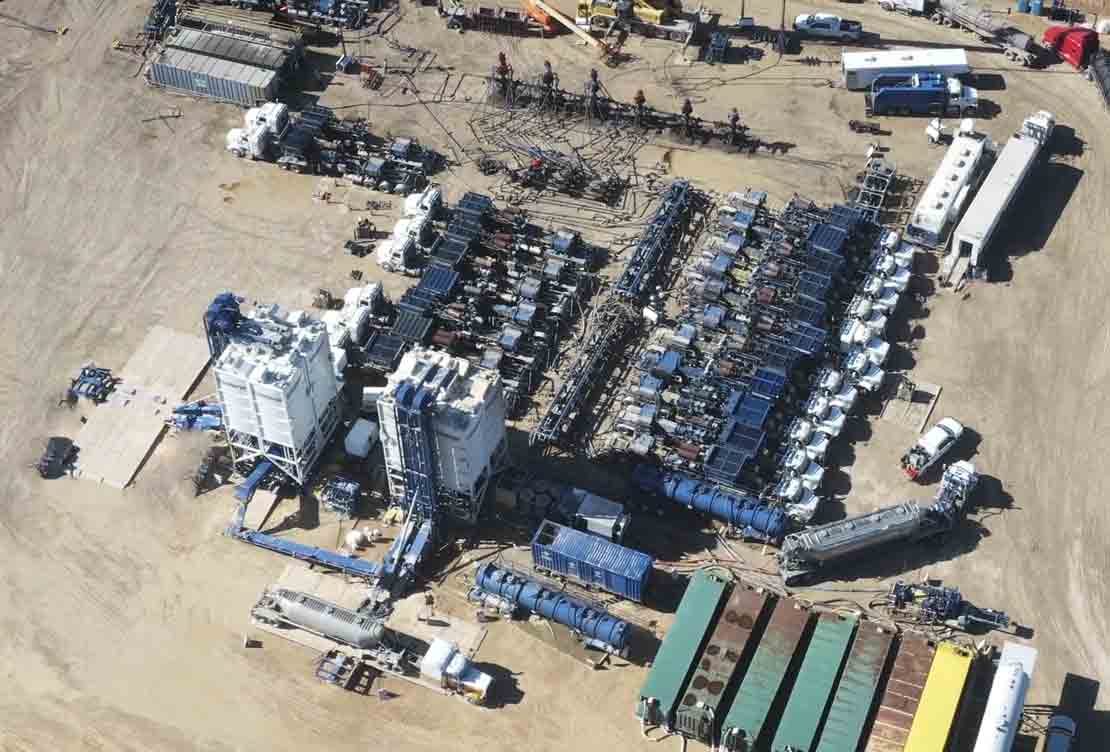
Aerial view of a stimulation site: rows of pump units, blenders and manifold trailers laid out around a wellhead.
A stimulation spread from above — the high-pressure iron the platform actuates, and the red zone nobody should be standing in.

Schlumberger · SLIIC2016 — 2019

ValveCommander

A cloud-controlled, diesel-engine-powered hydraulic and electric actuation system for high-risk, high-pressure operations. I managed its execution across the entire product lifecycle — inception and architecture through engineering, manufacturing, field trials and commercialization.

  • Owned the product end to end, from first architecture to commercial release
  • Awarded a top-5 innovation project across the entire company
  • Has been generating revenue for over a decade
  • Also built a custom testing system for characterizing nuclear detector photomultipliers
  • Created a high-precision software suite to quantify radiation detector accuracy for prototype validation
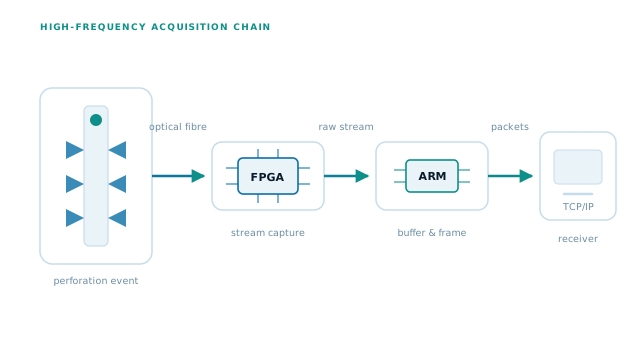
Diagram of a downhole perforation event captured over optical fibre, processed by an FPGA, buffered on an ARM microcontroller and transmitted over TCP/IP to a receiver.
Fibre to FPGA to MCU to the network — a capture chain measured in microseconds.

Schlumberger · Coiled Tubing2014 — 2015

High-frequency downhole acquisition

A device to capture high-frequency data from underground explosive perforations — transmitted over optical fibre, processed on FPGAs, handed to an ARM microcontroller and streamed over TCP/IP to a receiver at surface.

  • Designed the full acquisition chain across optics, programmable logic, firmware and networking
  • Then took it to the field: rigless well intervention with a team of five in the remote deserts of Saudi Arabia
  • Hands-on with fluid pumps, diesel engines, industrial hydraulics, liquid nitrogen and concentrated acid — the operational reality the software has to respect
The C-Shop editor: a dark desktop interface with a tool palette down the left, brush options along the top, a demo document of overlapping cyan, magenta and amber glows on the canvas, and colour, history, channels and layers panels docked on the right.
A single Rust binary compositing on the GPU — layers, masks and blend modes, on screen in about 400 ms.
The photograph: a tan and white dog sitting on a dark wooden park bench, head tipped back towards a hand reaching down to it, green trees blurred behind. the photograph
The same photograph with two green labelled boxes drawn over it by the editor itself: dog at 90 per cent around the animal, bench at 56 per cent around the seat below. what detect found
The dog alone against a transparency checkerboard, the bench, the hand and the trees all removed, individual strands of fur preserved along the edge. what segment cut out
Photograph to cut-out with nobody saying where anything is — and the boxes in the middle frame are drawn by C-Shop, from the detector’s own answer.

Personal · Open Source

C-Shop — a GPU-native image editor

A native, layer-based image editor written from scratch in Rust. No browser, no Electron, no web view — a Vulkan compositor and a real desktop binary that needs nothing beyond a working GPU driver. The same editor runs with no window at all, driven by a script instead of a pointer, and serves that harness over the network, so a caller elsewhere can edit an image and see what it drew.

  • ~55,000 lines of Rust and 500 of WGSL across five crates — document model, GPU compositor, I/O, interface and app shell
  • An agentic harness: the whole editor scripted headlessly, so a caller that cannot see a canvas still places type by measurement and reads back a report of exactly what it drew — served over MCP with a picture of the work in every result, the document held open between calls, and each path confined to a single workspace
  • Layers, groups, masks, re-editable type, Bézier paths and vector shapes with boolean operations, layer effects, 27 blend modes and non-destructive adjustment layers
  • 30 filters and a full selection stack, all evaluated on the GPU and checked against a CPU reference to within 0.84 of one 8-bit level
  • Seventeen named styles — parameterised script fragments that scale themselves to whatever image they are handed — and an optional vision pack that takes a photograph to a cut-out without anyone having to say where anything is
  • A native layered project format that reopens fully editable, plus PSD import and export and the usual flat formats, with ICC profiles read out of the containers directly, CMYK opened as four inks through the press's own profile, and 16-bit export that keeps the precision the compositor already computes
  • 733 tests, including GPU-versus-CPU pixel comparison, headless interface driving, fuzzed round trips of damaged files and the served editor exercised over a real socket
Next

Working on something in this shape?

If your program looks like one of the above — a vehicle that has to think for itself, a fleet that has to be operable, or a sensor stack that has to become a deliverable — I take on a small number of consulting engagements each year.